
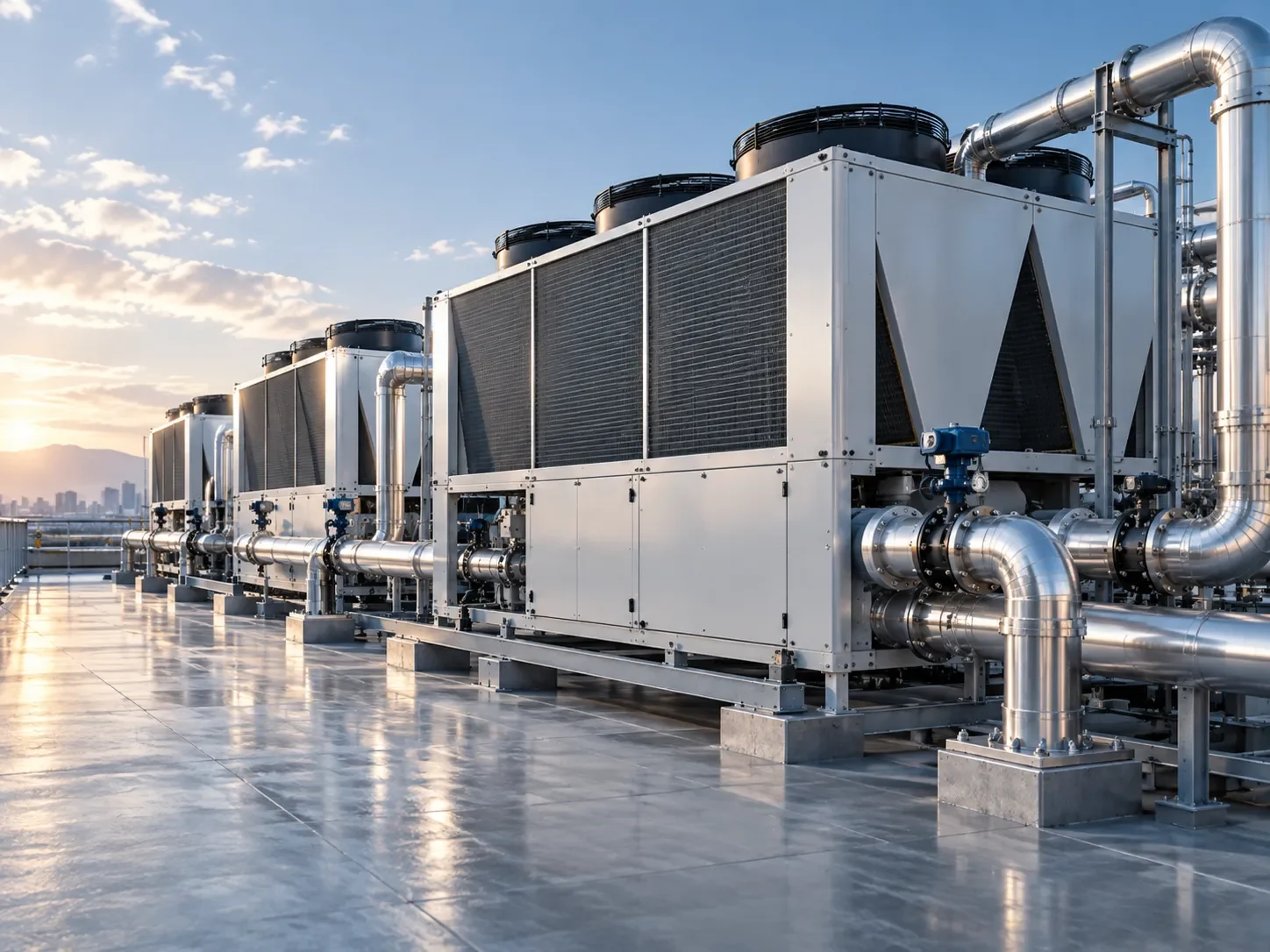
In large buildings and industrial facilities, cooling demand is too high to be met efficiently with individual air conditioners. This is where chiller systems come in. A chiller is a central cooling unit that chills water or a glycol solution and delivers this fluid to air handling units, fan coil units or production equipment throughout the building.
How Does a Chiller Work?
A chiller operates on the classic vapour-compression refrigeration cycle. In the evaporator, the refrigerant evaporates and absorbs heat from the water returning from the system, typically lowering it to around 6–7 °C. The compressor compresses the warmed refrigerant and sends it to the condenser, where the heat is rejected to the outdoor air or to a cooling tower. Pumps then distribute the chilled water to terminal units inside the building, and it returns to the chiller after absorbing heat.
Types of Chillers
- Air-cooled chillers: Reject condenser heat directly to the outdoor air using fans. Because no cooling tower is needed, they are practical to install and are usually placed on the roof or outside the building.
- Water-cooled chillers: Reject condenser heat via a cooling tower. They offer higher efficiency at large capacities and are usually located in a plant room.
- Process chillers: Designed for production processes such as plastic injection, food, pharmaceuticals and chemicals that require low and stable water temperatures.
Where Are Chillers Used?
Chiller systems are widely used in commercial buildings with high cooling loads, such as shopping centres, hospitals, hotels, airports and large office buildings. In data centres they remove the heat generated by servers, and in factories they are used for both space conditioning and process cooling.
Advantages of Chiller Systems
- High-capacity, controllable cooling from a single central plant
- Redundancy and uninterrupted operation through sequencing multiple units
- Energy savings with free cooling using outdoor air in cold seasons
- Hot water production from waste heat with heat recovery models
- Long equipment life and predictable maintenance
How to Choose the Right Chiller
The first step is an accurate calculation of the building's or process's cooling load. Oversizing causes the unit to cycle on and off frequently and lose efficiency. Installation location, access to a water source, noise limits, part-load efficiency and the refrigerant used are other key selection criteria. Correct design and balancing of the hydronic system is just as important as equipment selection for the system to reach its expected performance.
At DEMO Site, we provide design, installation and maintenance services for chiller systems. Explore our chiller units in various capacities and types, and contact us for the right solution for your facility.